
Have you ever opened an astrology software like Jagannatha Hora and found yourself staring at a “Preferences” menu asking you to choose an Ayanamsha? Options like True Lahiri, Raman, Krishnamurti, and Pushya Paksha pop up, leaving many beginners and even intermediate learners completely confused.
Choosing the right Ayanamsha is one of the most critical decisions you make when casting a chart. It has the power to shift planetary positions, alter your Mahadasha timelines, change your Antardashas, and even swap your Yogi or Avayogi planets.
Let’s break down the cosmic science behind Ayanamsha, how the earth’s movement affects your horoscope, and why Western and Vedic astrology diverge so radically.
What is Ayanamsha? The Science of Cosmic Drift
To understand Ayanamsha, we must look at the sky from the perspective of Earth. The entire zodiac belt sits on the Ecliptic, which is the apparent path the Sun tracks across the celestial sphere over a solar year.
Historically, around 285 AD, a fascinating cosmic alignment occurred: the Vernal Equinox (the point where the Sun crosses the celestial equator moving north) precisely coincided with the 0-degree starting point of Aries in the zodiac. At that moment in history, the astronomical sky and the astrological zodiac map were perfectly synced.
However, the Earth does not just rotate and revolve; it possesses a third movement—a slow wobbling effect known scientifically as the Precession of the Equinoxes. Because of this subtle wobble:
- The Vernal Equinox drifts backwards at a rate of about 50.3 seconds of arc per year.
- This accumulates to a 1-degree shift every 72 years.
- From 285 AD to today, the equinox point has drifted by approximately 24.1 degrees away from the fixed 0-degree Aries point.
“Ayana” means movement. Therefore, Ayanamsha is the exact measurement (in degrees, minutes, and seconds) of this cosmic shift. It represents the physical distance between the moving Vernal Equinox and the fixed starting point of astronomical Aries.
Sayana vs. Nirayana: Why Western and Vedic Astrology Differ
This astronomical drift is the core reason why Western and Vedic horoscopes look entirely different. They use two separate zodiac systems:
| Feature | Sayana System (Western Astrology) | Nirayana System (Vedic Astrology) |
|---|---|---|
| Ayanamsha Used? | No. It ignores the precession shift. | Yes. It continuously factors in the exact shift. |
| Zodiac Type | Tropical Zodiac (Fixed to seasons). | Sidereal Zodiac (Fixed to actual stars). |
| Aries Start Date | Always fixed to the Vernal Equinox (March 21). | Moves with actual constellations (around April 14). |
| Core Focus | Solar placement relative to Earth’s seasonal quadrants. | Exact physical placement of planets against fixed stars. |
Because Western astrology ignores this 24-degree drift, magazine horoscopes state that if you are born on March 22, you are an Aries Sun. But astronomically, because the sky has shifted, the Sun hasn’t actually entered the physical constellation of Aries yet—it enters around April 14 according to the corrected Vedic system.
Which Ayanamsha Should You Use?
Because calculating this deep-space drift requires tracking fixed reference points, different astronomers and sages used slightly different anchor stars, leading to various Ayanamsha options:
- True Lahiri Ayanamsha (Chitra Paksha): This is the most widely trusted standard used in India. It uses the fixed star Spica (Chitra Nakshatra) as an anchor, calculating the Aries starting point exactly 180 degrees opposite to it. It has been officially certified by the Government of India to standardize national calendars and festival dates.
- BV Raman Ayanamsha: Popularized by the legendary astrologer Bangalore Venkata Raman, it assumes a slightly different zero-year alignment, creating a shift of about 1° 26′ less than Lahiri.
- KP Ayanamsha (Krishnamurti Paddhati): Primarily utilized in stellar astrology for precise sub-lord calculations, sitting very close to Lahiri with a minor difference of just a few arcminutes.
- Pushya Paksha Ayanamsha: An ancient methodology anchoring the zodiac calculations directly onto the Pushya Nakshatra, gaining popularity for its mathematical symmetry in planetary calculations.
The Cosmic Clock: Tracking the Ayanamsha Through 3 Eras
Because the Ayanamsha value changes continuously over its 25,920-year precessional cycle, we can look back at history to see exactly how Earth’s axis changed the stars behind our seasons:
1. The Modern Day Era (2026 CE)
- The Nakshatra: Uttara Bhadrapada (Pisces / Meena Rashi).
- The Reality: Because the equinox point has drifted backward by approximately 24.1° from the 0° Aries baseline, the Vernal Equinox no longer occurs in Aries. It has retrograded entirely out of Aries and sits deep inside the sign of Pisces.
2. The Classical Baseline Era (c. 285 AD)
- The Nakshatra: Ashvini Nakshatra (0° Aries).
- The Reality: This is the temporal anchor for the True Lahiri Ayanamsha. At this point in history, the Vernal Equinox intersected the celestial equator exactly at the starting boundary of Ashvini, making the Ayanamsha value exactly 0 degrees.
3. The Ancient Vedic Era (c. 2000 BCE – 2300 BCE)
- The Nakshatra: Krittika Nakshatra (Pleiades star cluster).
- The Reality: Ancient texts like the Atharva Veda or the Shatapatha Brahmana do not begin their Nakshatra lists with Ashvini—they explicitly begin with Krittika. This is because the physical precession wobble placed the Spring Equinox point against the backdrop of the Pleiades cluster thousands of years ago.
| Era | Spring Equinox | Uttarayan (Winter Solstice) | Dakshinayan (Summer Solstice) |
|---|---|---|---|
| Mahabharata Era (c. 3100 BCE) | Rohini (Taurus) | Shravana / Dhanishta | Magha / Ashlesha |
| Classical Anchor (c. 285 AD) | Ashvini (0° Aries) | Uttarashadha (0° Capricorn) | Punarvasu (0° Cancer) |
| Modern Day (2026) | Uttara Bhadrapada (Pisces) | Mula (Sagittarius) | Ardra (Gemini) |
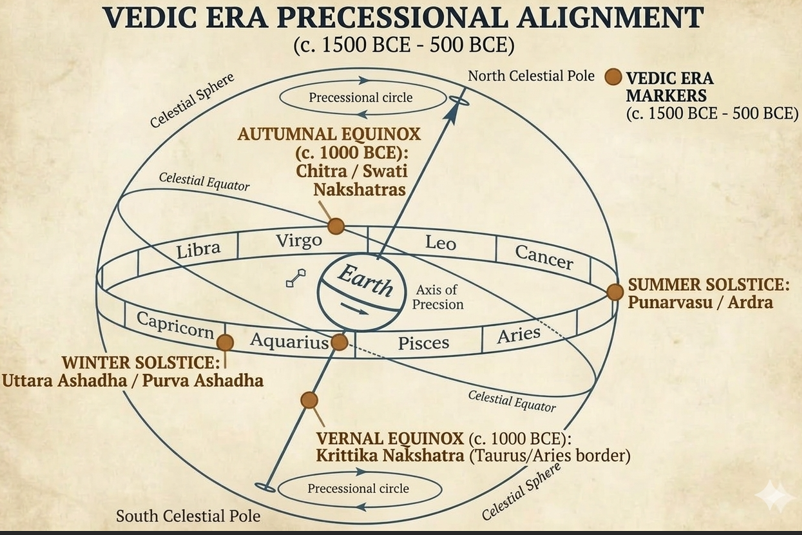
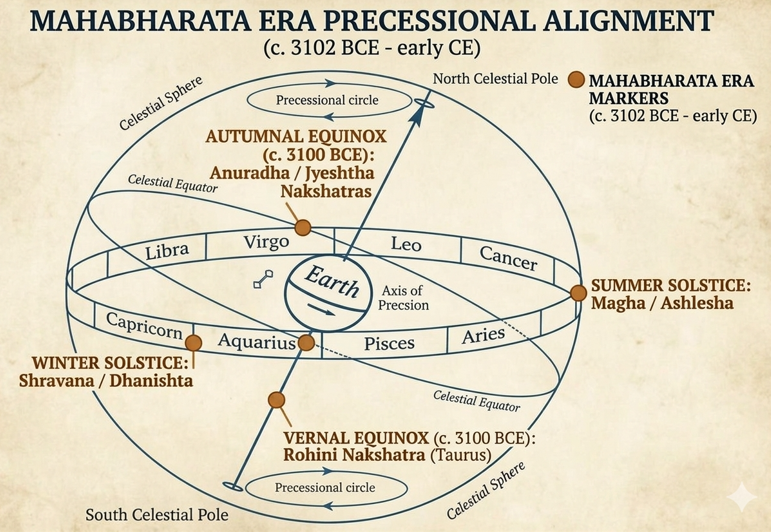
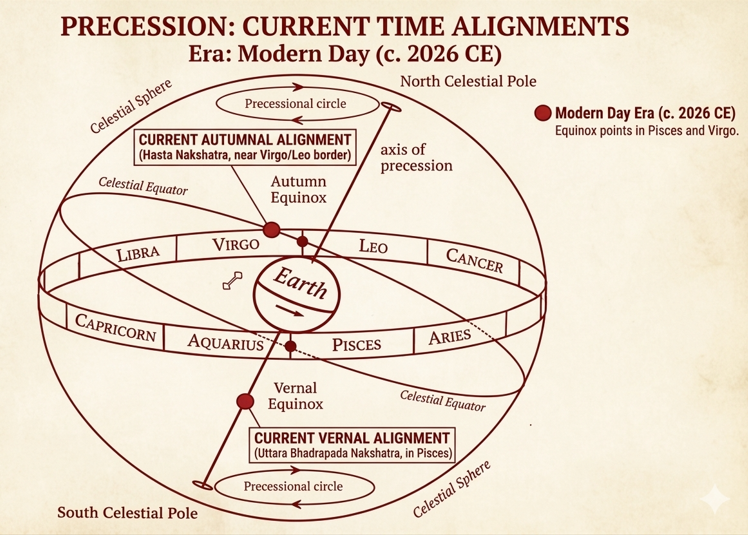
The Precessional Drift (Ayanamsha Shift)
This calculation represents the time the Equinox point (the position of the Sun on March 21st) takes to crawl backward through the constellations due to Earth’s axial wobble. This is what shifts our Ayanamsha over long historical eras.
Rate of Precessional Drift: Approx. 50.3 arcseconds per year.
1 Degree Shift:
3600 arcseconds / 50.3 = 71.58 years (Commonly rounded to 72 years).
Calculation for One Nakshatra (13 degrees 20 minutes):
One Nakshatra equals 13.333 degrees, which contains exactly 48,000 arcseconds (13.333 x 3600).
Time to cross one Nakshatra = 48,000 arcseconds / 50.3 arcseconds/year = 954.27 years (Commonly rounded to 960 years in traditional approximations).
Calculation for All 27 Nakshatras (Full Precession Cycle):
Time for full cycle = 954.27 years x 27 Nakshatras = 25,765 years (Commonly referred to as the Great Platonic Year or 25,920 years in traditional cycles using a flat 72-year/degree rule).
Ayanamsha Use Case: Why Precession Matters for an Ephemeris
The calculations of Earth’s precession and axial tilt are fundamentally used to create an Ephemeris (Panchang).
Without accounting for these exact movements, it is mathematically impossible to calculate the accurate daily positions of heavenly bodies. Here is how this data is applied in both traditional and modern systems:
1. Indian Panchang and the Ayanamsha
Traditional Indian almanacs rely heavily on these calculations to correct the coordinate systems over time:
- Sidereal System (Nirayana): Vedic astronomy tracks the planets against the actual, fixed background constellations.
- The Correction Factor: Because the spring equinox point slides backward by about 50.3 arcseconds per year, Indian astrologers use a correction factor called Ayanamsha.
- If astronomers do not factor in this precessional drift, the planetary positions printed in the Panchang will completely mismatch where the planets actually appear in the physical sky.
2. Modern Astronomical Ephemeris
Global scientific agencies (like NASA’s Jet Propulsion Laboratory) publish highly advanced Ephemeris tables using exact planetary data, utilizing these two critical factors:
- Precession Mapping: This defines the shifting “zero-point” (Vernal Equinox) of the celestial coordinate grid to keep modern satellite trackings mathematically accurate over long centuries.
- Obliquity Data: Knowing that Earth’s axial tilt was 23.81° in the Vedic era and is 23.44° today allows computers to accurately map the north-south declination of the Sun and planets.
In short: Whether it is an ancient Sanskrit text calculating planet positions using the Surya Siddhanta or a modern digital spreadsheet generated by supercomputers, tracking the movement of Earth’s axis is completely mandatory to build an Ephemeris.