
Most astrologers try to find the answers to every life event using only the nine primary planets (Navagrahas). When something goes wrong, it is incredibly common to see the blame pinned entirely on Shani (Saturn), Rahu, and Ketu. But is the cosmic blueprint really that simplistic?
The truth is, traditional astrology holds a treasure trove of hidden mathematical points that many modern practitioners completely miss.
While the physical planets represent the core energies operating in your life, there are highly sensitive, calculated points in a chart that act as precise triggers for destiny. In this blog, we are going to move past the surface-level blame game and dive deep into these overlooked factors.
Introduction to Trisphuta
In Vedic astrology—specifically the highly precise Prasna system—Trisphuta is a highly sensitive, mathematically calculated coordinate. The word itself translates to “The Three-Fold Conjunction.”
It represents the exact point where three distinct astrological energies merge:
- Lagna Sphuta (The Physical Self / Ascendant)
- Chandra Sphuta (The Mind & Vital Fluids / Moon)
- Gulika Sphuta (The Sub-planet of Karmic Debts / Saturn’s toxic shadow)
Unlike planets, Trisphuta has no physical body. Instead, it acts like a cosmic tripwire or an alignment sensor. If the beneficial, protecting planets cross this point, it signals profound resilience and vitality. If malefic planets or death-inflicting vectors cross it, it signals severe health vulnerabilities or danger to longevity.
Why is it “Hidden” in Most Astrology Charts?
If you pull up a standard chart on most mainstream mobile apps or websites, you will never see a label for Trisphuta. It is hidden for three main reasons:
- It Belongs to Specialized Texts: Most basic software is built purely on Parashari principles (BPHS). Trisphuta belongs to Prasna Marga, an advanced text specializing in life-and-death analysis, medical astrology, and horary readings.
- It requires Sub-Point Math: It cannot be calculated just by looking at a sign placement. It requires converting three separate positions into precise absolute degrees (0° to 360°), down to the exact arcseconds, and summing them up.
- It Changes by the Minute: Because it incorporates Gulika (which moves rapidly based on the precise second of local sunrise) and the Lagna (which changes signs every two hours), Trisphuta is extremely fluid. Even a two-minute error in birth time will completely throw off the result.
How to Find the Trisphuta Point in Your Chart
Trisphuta Formula:
Trisphuta = Lagna Longitude + Moon Longitude + Gulika Longitude
Adjustment Rule:
If the total sum exceeds 360 degrees, subtract 360 degrees (or multiples of 360) until the final value falls within the 0 to 360 degree zodiac window.
Example: DOB : 14 Feb 2019, Time: 08:39, Place: Delhi
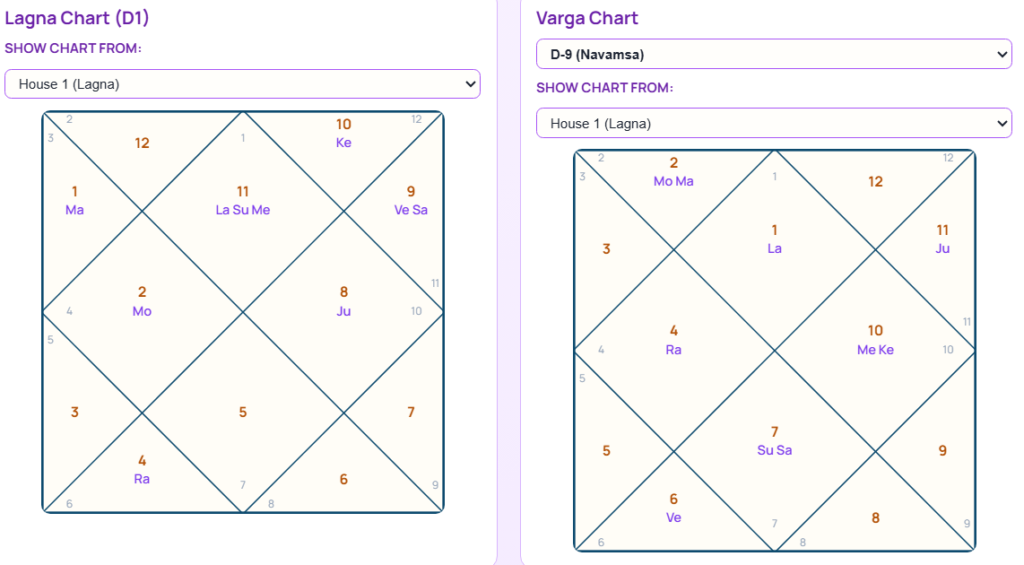
Lagna – 23 Aq 23′ 52.02″
Sun – 1 Aq 00′ 21.21″
Moon – 15 Ta 28′ 03.14″
Gulika – 28 Pi 37′ 47.30″
Step 1: Convert Positions to Absolute 360° Degrees
First, we calculate the absolute numerical degrees for Lagna, Moon, and Gulika based on their zodiac positions:
Lagna: 23° Aquarius 23′ 52.02″
- Aquarius means 10 signs have passed (10 x 30° = 300°)
- Absolute Degree: 300° + 23° 23′ 52.02″ = 323° 23′ 52.02″
Moon: 15° Taurus 28′ 03.14″
- Taurus means 1 sign has passed (1 x 30° = 30°)
- Absolute Degree: 30° + 15° 28′ 03.14″ = 45° 28′ 03.14″
Gulika: 28° Pisces 37′ 47.30″
- Pisces means 11 signs have passed (11 x 30° = 330°)
- Absolute Degree: 330° + 28° 37′ 47.30″ = 358° 37′ 47.30″
Step 2: Calculate Trisphuta Longitude
Add the three absolute values together= 323° 23′ 52.02″ + 45° 28′ 03.14″ + 358° 37′ 47.30″ = 727° 29′ 42.46″
Now apply the 360° adjustment rule (subtract 360° until the result is under 360°):
- 727° 29′ 42.46″ – 360° = 367° 29′ 42.46″
- 367° 29′ 42.46″ – 360° = 7° 29′ 42.46″
A longitude of 7° 29′ 42.46″ places Trisphuta in the first sign of the zodiac: Aries (Ar).
- Finding Praana (Life Force): Look at the Navamsa sign of your Lagna.
- Finding Deha (The Physical Body): Look at the Navamsa sign of your Moon.
- Finding Mrityu (Death Vector): Look at the Navamsa sign of your Gulika.
Final Summary: The Sensitive Point Matrix
Based on our example calculation coordinates, here is how the primary core sensitive centers map out in the natal and divisional structure:
- Praana (Vital Life Force): Taurus (D-9 Navamsha Lagna)
- Deha (The Physical Body Container): Taurus (Moon Position in D-9 Navamsha)
- Mrityu (The Death and Vulnerability Point): Pisces (Gulika Position in D-9 Navamsha)
- Trisphuta (The Combined Cosmic Seed Coordinate): Aries (Absolute Longitude Position)
- Kaala (Destructive Time / Planetary Clock): Gemini (Trisphuta Position mapped to D-9 Navamsha)
| Sensitive Vector | Representing | Sign (Rashi) | Divisional Seat (D-9) |
|---|---|---|---|
| Praana | Vital Life Force | — | Taurus |
| Deha | The Physical Body | — | Taurus |
| Mrityu | Death & Vulnerability | — | Pisces |
| Trisphuta | Combined Cosmic Seed | Aries | — |
| Kaala | Destructive Time | — | Gemini |
How to Analyze the Trisphuta Matrix in a Chart
Once you have located Praana, Deha, Kaala, and Mrityu in your chart, use these classical rules from Prasna Marga to interpret the results:
Rules for Praana and Deha (The Protective Pillars):
- A house containing the sign of Deha or Praana becomes prosperous and brings good fortune, unless it happens to be the 6th, 8th, or 12th house.
- Deha and Praana should never be afflicted by or associated with malefic planets. If they are heavily afflicted, it ruins the overall strength and goodness of the entire horoscope.
Rules for Kaala and Mrityu (The Vulnerability Pillars):
- Any house holding the sign of Kaala or Mrityu loses most of its positive benefits and good indications.
- If Kaala or Mrityu falls directly in the 1st house (Lagna), it severely curtails the native’s longevity.
- If Kaala or Mrityu falls in the 6th, 8th, or 12th houses, it causes a wide variety of persistent miseries, health issues, and troubles.
Danger Configurations (When Things Get Critical):
- If any of the four sensitive signs (Praana, Deha, Mrityu, or Kaala) land in the 1st, 6th, 8th, or 12th houses AND get associated with functional malefic planets, it poses a direct hazard to the life and well-being of the native.
- The lord (ruler planet) of the Kaala or Mrityu sign should not form an intimate relationship or aspect with the Lagna, as it transmits negative karmic triggers directly to the physical self.
Conclusion:
The Rule of Trisphuta shows us just how layered and deeply mathematical Vedic astrology truly is. It serves as a reminder that we cannot analyze longevity or health simply by looking at the surface-level placements of major planets. By unlocking hidden calculations like Praana, Deha, Mrityu, and Kaala, we gain access to a highly precise diagnostic tool.
Remember, finding a sensitive point in a difficult house isn’t a reason to panic. Astrology is a holistic map of fluid trends, and several massive overriding factors can completely alter these outcomes. For instance, the baseline strength of your Panchang elements (such as a highly favorable Tithi, Vara, or Nakshatra) provides an underlying shield of deep cosmic vitality. Furthermore, a strong, protective aspect from a natural benefic planet like Jupiter, Venus, or a well-placed Mercury can neutralize these sensitive points and entirely change the final reading. Look at your chart as a complete ecosystem where protective blessings and karmic vulnerabilities constantly balance each other out.
Deepen Your Knowledge (Related Read)
If you want to look even closer at these hidden cosmic tripwires and master the advanced mechanics of non-luminous shadow planets, check out this comprehensive guide: